The Dialectics of Art
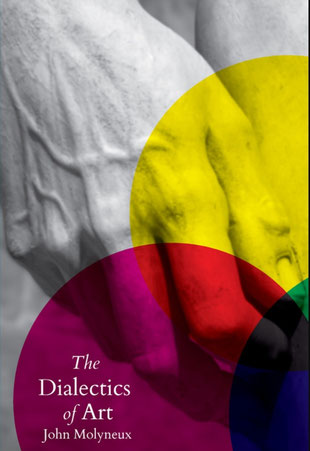
(A review of The Dialectics of Art by John Molyneux, first published by Irish Marxist Review.)
We “are forced to note how often it has been the fate of great radical art [to] be taken up by our rulers”, writes John Molyneux of Jackson Pollock’s “drip paintings” (ca. 1947-1950): “The solution is not to renounce the art but to expropriate our rulers.” As here, the essays collected in The Dialectics of Art as a whole are immediately recognisable for their eloquence and radical fire.
Formally attentive and politically astute, Molyneux’s criticism is singular in its fierce clarity of response to a number of leading visual artists and their works, and indeed to the looming question, “What Is Art?” (a subject meticulously examined in the opening chapter). Such a combination of elements is both winning and rare. “Without obvious patterning”, Molyneux further suggests of Pollock’s work, which was promoted for its supposed Americanism by the CIA in later years, these paintings “achieve a total symphonic composition”, a quality that “speaks of the struggle against alienation, fragmentation and disintegration.” When “Holbein paints the portrait of Henry VIII”, a later segment likewise observes, “he is painting not just the man, Henry Tudor, but the institution of kingship at that moment in English history”, thus joining technical mastery to a vision of the “social relations” of his epoch, in a work that therefore will be found valuable by any aspiring aficionados (whether of art or revolution) with their wits about them.
Molyneux cites John Berger’s recognition of art’s role as a possible “model of freedom” as a kind of guiding principle to the approach adopted in these articles, even if his own interpretations of specific artists and paintings diverge from Berger’s in important respects. Whereas the latter views the “dislocations” in evidence in Picasso’s “revolutionary” Les Desmoiselles d’Avignon (1907) as “the result of aggression, not aesthetics”, a protest against civilisation as such, Molyneux qualifies this perception by foregrounding the fact, largely downplayed by critics, that the painting in question “is a picture of prostitutes and is about prostitution.” Picasso’s masterpiece, Molyneux contends, “is a uniquely intense and dramatic depiction of the mutual antagonism, estrangement and alienation involved in the institution of prostitution”, itself indicative of the dehumanising relations generated and sustained by capitalist social systems as a matter of course. It’s a compelling reading of a visceral and potentially disturbing image, and serves as an illuminating counterpoint to Molyneux’s commentary on Rembrandt, whose painting, The Jewish Bride (ca. 1665), he presents memorably: as a work,
… in which forty years of accumulated craft and experience in the laying of paint on canvas are brought to bear, not for a display of virtuosity [on Rembrandt’s part] but in order to make a visual statement about the potential for love between two human beings.
It is to Molyneux’s credit that the complexities of such questions, the technical literacy required to appreciate “accumulated craft” in the visual arts in general, and the Marxist grounding of his analysis are integrated so fluently. His commentaries are never less than cogent, and often shine with the insight and enthusiasm of a true student of human emancipation, a critic who believes in the part that the creation and appreciation of art can play in such a history.
In some ways, Molyneux’s book stands as a useful field guide for students of the Marxist tradition, artistic or otherwise. He makes frequent use of economic and cultural writings by Marx, Engels, and Trotsky to clarify his own interpretive stance. Trotsky’s adage, for example, that “a protest against reality, either conscious or unconscious, active or passive, optimistic or pessimistic, always forms part of a really creative piece of work” is deployed to elucidating effect: indeed, it’s an insight that may be taken as propelling Molyneux’s critical approach.
In its honed receptivity to individual art-works, its subtle yet accessible interrogation of single images for a new understanding of human conditions (whether interior or relational, individual or super-structural), The Dialectics of Art may also bear comparison to the work of Walter Benjamin. It was Benjamin, after all, who wrote of history “as a picture, which flashes its final farewell in the moment of its recognizability”, and yet who insisted that “[the] truth will not run away from us”:
For it is an irretrievable picture of the past, which threatens to disappear with every present, which does not recognize itself as meant in it.
Molyneux’s urge to draw the masterpieces of the visual arts back into the light of proletarian (i.e. human and humane) progress arguably holds something of a family resemblance to Benjamin’s philosophy, as both writers unlock revolutionary perspectives from inside the forms (and objects) of their attention, to be reclaimed in future work and understanding.
This is not to say that Molyneux has offered the final word (or radical perspective) on the arts, and nor does he claim to have achieved or desired this. Dialectics is best approached as an eclectic and original blueprint for further explorations in the field, and perhaps farther afield. Critical scrutiny will be a key element in that process. On the face of it, few would object to Molyneux’s proposition that art be understood as an expression of “free creative labour in a world dominated by the opposite”, which therefore should be “supported and nourished” by socialists. Similarly, the powerful recognition that even “under extreme fascist and authoritarian regimes, art survives in numerous nooks and crannies”, including “concentration camps”, is instructive and historically accurate – but holds an uneasy continuity with the somewhat under-stated admission, one page earlier, that not all creative works are “beneficial to humanity”, with Leni Riefenstahl’s fascist Triumph of the Will (1935) cited as a case in point. For all their care and apparent lucidity, Molyneux’s definitions of art (as elaborated in the opening two sections of the book in particular) do not fully address some of the problematic overlaps that they allow: in this instance, between the “free creative labour” that produced a work and its authoritarian content and/or funding.
Another tension emerges, albeit obliquely, in the otherwise stirring overview of Yasser Alwan’s proletarian photographs, which Molyneux praises for showing “that working people, despite poverty and toil, remain complex and dignified human beings [with] their own take on life and the world.” In the essay, Molyneux makes a point of cutting through the myths and spotlighting the “profound ignorance” of the contemporary art establishment in the West (Europe and North America):
Ask a British university class (I have tried this often) to name three non-Western artists [and] you are setting a test which the large majority are destined to fail…. Results would not be much better among the faculty.
There is of course an irony here, in that Molyneux’s own critical focus (at least as represented by the selection of essays in this book) rarely strays from the work of canonical male artists, albeit of varying backgrounds, political sensibilities, and styles. Tracey Emin and Rachel Whiteread receive due tribute, Emin with a chapter of her own; Käthe Kollwitz and Dorothea Lange are mentioned elsewhere in passing, but not discussed; Mexican photographer and revolutionary, Tina Modotti, is glimpsed in parenthesis; Frida Kahlo’s work is briefly referenced alongside that of her husband, Diego Rivera, in a suggestive, if under-developed comparison included in the opening chapter. Given Molyneux’s blend of sensitivity to technical and emotional nuance with a clear-eyed (Marxist) appreciation for human creativity and proletarian agency as such, the absence of a fuller engagement with these artists, and others, seems a diminishment of the book’s scope and import. “[W]hatever about Renaissance Europe”, Molyneux writes, regarding the best means of tracking the historical development of art as an overall tendency in class societies through time, “what happens when we throw Chinese, Japanese, Indian, Central and South American and African art into the mix?” As above, we never quite find out.
This caveat, of course, does not change the fact that Molyneux’s conclusions, as they stand, are both refreshing and persuasive. Perhaps the point is to avoid fixating on tradition and fetishising the form of the artworks per se, and instead focus, as the essays in Dialectics resoundingly do, on the fact that non-alienated work, a non-alienated world, is possible: our task is to learn its language, to develop our creative skills and powers of attention (our capacity both to appreciate and to produce), thus coming into our own potential, individually and as a collective. Molyneux’s model of art criticism provides a valuable and inspiring starting-point for such a project, made all the more vital by the pending ecological and civilisational crises to which our own era of capitalist hegemony (and resistance) seems to be driving.