Song of the Fallen
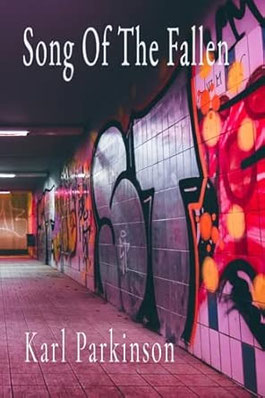
(A review of Song of the Fallen by Karl Parkinson)
At a time when most contemporary poets seem to believe in very little – more interested in their own brand, and prospects for self-advancement, than they are in poetry, even – Karl Parkinson emerges from the churning rubbish-heap of history, chanting his song like a new prophet, his vision stained and glorified by the grime of Dublin's streets. He is as heaven-haunted as William Blake, as noisily self-projecting as Walt Whitman. His poems are auguries, all fisted guts and scorching tears – elegising the dead while raising prayers to the harsh, beating fever-dream of life, a shadow moving “in the dark opal-hued morning light.”
In Song of the Fallen (2026), his latest poetry collection, Parkinson proclaims himself the bard of the disregarded, tribune of the dispossessed. “To be born a fly / is of the utmost importance”, he writes, “For they eat shit and trash, / and humans produce such a lot of it.” (As Allen Ginsberg noted, “It's hard to eat shit, without having visions.”) “I love all the junkies in Ireland”, he continues, “I love prostitutes and strippers. / I love every criminal locked up in a cell.” These “are my people and I am their poet.”
In all of this, Parkinson draws strength from the work of fellow undergrounders: poets like Dave Lordan, “great brother of the lyric-lapping, yapping tongue”, or Raven, for many years the spirit-guide of Irish spoken-word, now departed – “drowned by Neptune, / pulled in to a whirlpool.” Like them, he combines documentary fury with the second sight of revelation – in his case, gathering up the wasted bodies, the destroyed lives, of contemporary Dublin, in a chorus that dignifies the dead without sentimentalising what they were forced to suffer. “Rosy-fingered dawn DNGAF. / A final choir croaks Jerusalem”, he rages, as he assembles a litany of those many people (relatives, friends, neighbours) “I've known, / banged out, or burned out, or shot down, / or stabbed in the heart, or OD'd on bad gear”.
While Ireland's illustrious literati continue to recite variations on the same old stories, Parkinson has produced, among other things, a literature of witness – consoling and denunciatory – that tallies the full effect of government policies designed to deepen inequality, to privatise and gentrify our cities, to convert our streets and flats and community halls into feeding-grounds for landlords and vulture-funds. In his own words, he writes for “the high rise flats and maddest estates” in Dublin:
For O'Devaney Gardens, Sean McDermott Street.
For Sheriff Street flats, Ballymun and Gardiner Street.
For Coolock, Finglas, Summerhill and Kevin Barry.
Against the image we receive in tourist videos and state-sponsored advertisements, he tells the truth about Ireland's capital, where “Pipe bombs explode in the street”: “Asylum shelters burn to the ground.”
As the painful personal elegies in this collection make clear, Parkinson understands better than most the hurt and desperation of “Trying to outrun Death. / Trying to raise the dead.” But his approach – here, and across his past work – is both brutal and loving, filled with care and grief in spades. “Should I meet him in a dream”, he says of his “Da”, who died of a brain aneurysm at forty-three, “in Hades, or Paradise, / he will be the younger man, not I.” Meanwhile, the tributes to his partner Natasha (“muse of mine, queen of the tribe”) shine with poetic passion.
Song of the Fallen sometimes staggers under the weight of its own rhetorical ambitions, but it's also a forceful chronicle, managing to feel both rooted and expansive, which Irish poetry would be far poorer without. In his intensity and courage, Parkinson has proven himself – once again – a writer of singular power.